Jugnix · free physics worksheets
Concave & Convex Mirrors Worksheet
By the end you will: find the image for every position of the object, use the mirror formula, and draw ray diagrams.
A. Explore with the simulation
Choose Concave with a focal length of 15 cm. Use the “Put the object…” buttons and fill in the table.
Object Position of image Size of image Nature of image Beyond C At C C–F At F Inside F Choose Plane and set the object 20 cm from the mirror. Where is the image, and how big is it?
Choose Convex and try every distance. Can you ever make the image bigger than the object? Where does the image form?
B. Calculate (then check in the simulation)
An object is 20 cm in front of a concave mirror of focal length 15 cm. Use 1/v + 1/u = 1/f to find v, then find m = −v/u.
An object is 30 cm in front of a convex mirror of focal length 15 cm. Find v and m.
Which mirror, and where is the object, in (a) a shaving mirror, (b) a vehicle's rear-view mirror, (c) a torch reflector?
C. Draw it
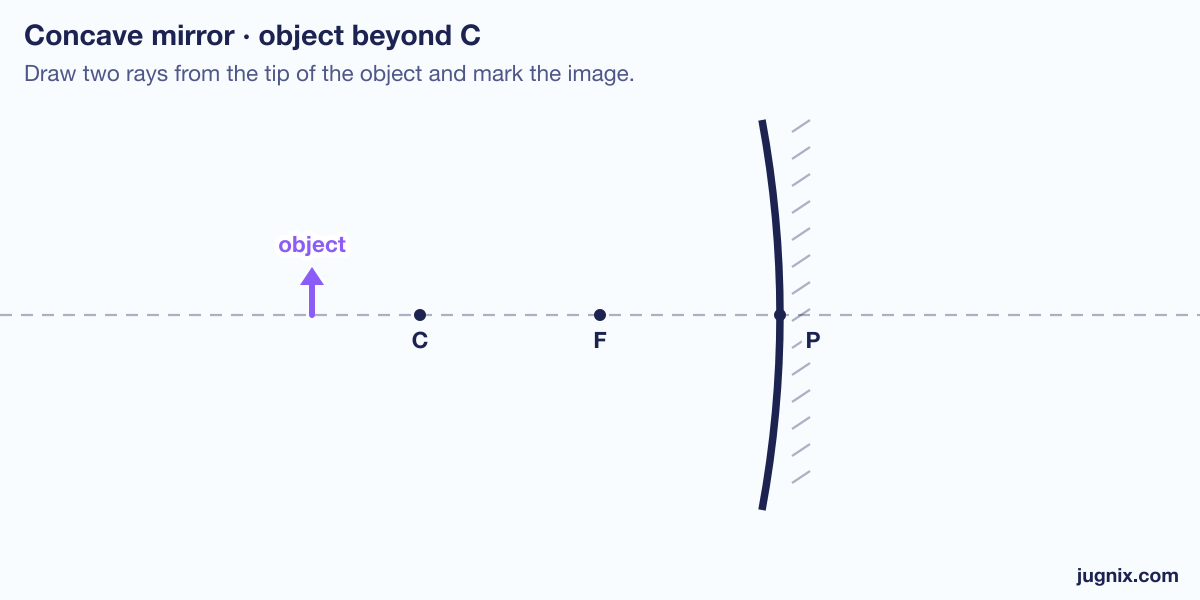
Draw two rays from the tip of the object, then mark the image. Describe it.
Answer key (for teachers and parents)
- Beyond C: between F and C, diminished, real and inverted · At C: at C, same size, real and inverted · Between C and F: beyond C, enlarged, real and inverted · At F: at infinity, highly enlarged, real and inverted · Between P and F: behind the mirror, enlarged, virtual and erect.
- 20 cm behind the mirror (v = +20 cm), the same size (m = 1), virtual and erect.
- No. A convex mirror always gives a virtual, erect, diminished image behind the mirror, between P and F.
- u = −20 cm, f = −15 cm. 1/v = −1/15 + 1/20 = −1/60, so v = −60 cm (in front of the mirror). m = −(−60) ÷ (−20) = −3: real, inverted, three times bigger.
- u = −30 cm, f = +15 cm. 1/v = 1/15 + 1/30 = 1/10, so v = +10 cm (behind the mirror). m = −10 ÷ (−30) = +0.33: virtual, erect, one third the size.
- (a) Concave, face between P and F, for an enlarged upright image. (b) Convex: it always shows an upright image and a wider view. (c) Concave, bulb at F, so the light comes out as a parallel beam.
- A ray parallel to the axis reflects through F; a ray through F reflects parallel to the axis. They meet between F and C, below the axis: a real, inverted, diminished image. See the solved diagram on the Mirrors simulation page.
Free to print and share for teaching. Made with the interactive simulation at jugnix.com/simulations/mirrors.