Jugnix · free physics worksheets
Phases of the Moon Worksheet
By the end you will: explain why the Moon's shape changes, name all eight phases in order, and say when eclipses can happen.
A. Explore with the simulation
Press 🌕 Full. Where is the Moon compared with Earth and the Sun?
Press each button and fill in the table from the readouts below the simulation.
Button Phase name Lit up (%) Moon's age (day) Rises around 🌑 New 🌓 1st Qtr 🌕 Full 🌗 3rd Qtr Press 🌑 New, then Play. For the next few days, is the lit part growing or shrinking? Which side of the Moon is lit?
Watch a whole cycle. About how many days is it from one Full Moon to the next?
B. Think it through
The Sun always lights up half of the Moon. So why do we see different shapes during the month?
Why can a solar eclipse happen only on a New Moon day (Amavasya)?
Make a lunar eclipse in the simulation. At which phase did it happen? Why don't we get one every month?
C. Name the phase
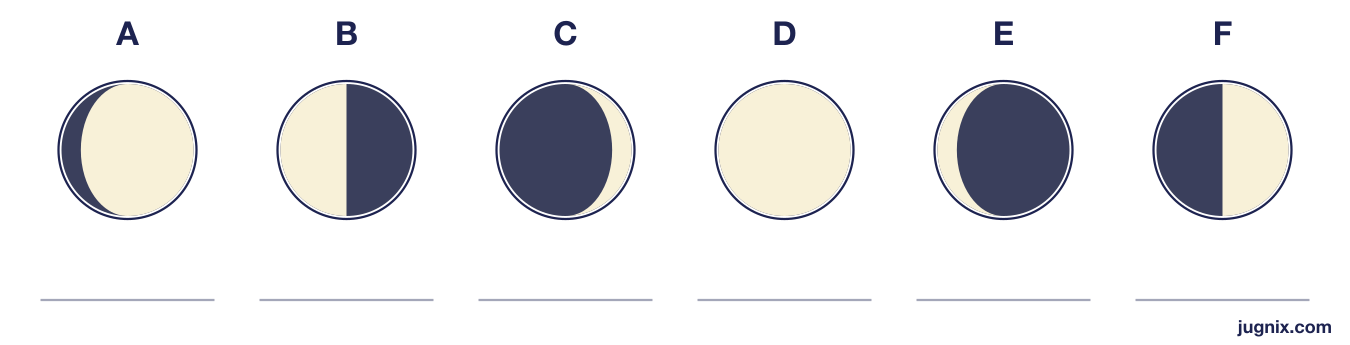
Write the name of each phase on the line under it. Then write the letters in order, starting just after New Moon.
Answer key (for teachers and parents)
- On the far side of Earth from the Sun. The Sun, Earth and Moon are in a line, with Earth in the middle.
- New Moon, 0%, day 0, 6 AM · First Quarter, 50%, day 7, noon · Full Moon, 100%, day 14, 6 PM · Third Quarter, 50%, day 22, midnight.
- Growing (waxing, Shukla Paksha). The lit part is on the right side, as seen from India.
- About 29.5 days (one synodic month).
- As the Moon goes around Earth, we see different amounts of its lit half. At New Moon the lit half faces away from us; at Full Moon it faces us completely; in between we see part of it.
- A solar eclipse needs the Moon between the Sun and Earth, and that is exactly where the Moon is at New Moon.
- At Full Moon. The Moon's orbit is tilted about 5° to Earth's, so most months the Full Moon passes just above or below Earth's shadow. Eclipses happen only when the line-up is exact, in the eclipse seasons.
- A Waxing Gibbous, B Third Quarter, C Waxing Crescent, D Full Moon, E Waning Crescent, F First Quarter. In order: C, F, A, D, B, E.
Free to print and share for teaching. Made with the interactive simulation at jugnix.com/simulations/moon-phases.